
College tennis recruiting is about more than finding a roster spot. Learn how to evaluate academics, athletics, career opportunities and long-term fit.

College tennis recruiting is changing again, and families in the classes of 2027, 2028 and 2029 need to understand what these changes could mean for the opportunities available to them.
The NCAA has adopted a new age-based eligibility model that significantly changes how Division I athletic eligibility is calculated. Instead of tracking traditional seasons of competition, redshirts and many waiver opportunities, the new system centers around a continuous five-year eligibility period.
For tennis families, this is more than an NCAA rule change. It could have a direct impact on how coaches build their rosters, how quickly recruiting decisions are made and how many opportunities are available to incoming players.
Under the new model, an athlete's five-year eligibility period begins at the earlier of:
Their initial full-time enrollment in college, or
The applicable academic year following their 19th birthday.
Once that eligibility period begins, the clock runs continuously. Sitting out, transferring, changing teams or simply not competing does not stop it.
The new rules also eliminate traditional athletic redshirts, seasons-of-competition tracking and several waiver categories, including medical hardship and extension-of-eligibility waivers. Limited exceptions remain for circumstances such as pregnancy, active-duty military service and qualifying religious or similar service commitments.
For athletes who first enroll full time in fall 2027 or later, the age-based model will be the standard. Athletes entering college during the 2026-27 academic year fall under transition rules.
The rule itself is about eligibility.
The recruiting implications could be much bigger.
When athletes have the potential to remain eligible for a longer period of competition, coaches have another reason to think carefully about roster continuity, player development and when they truly need to bring in someone new.
That can make an already competitive recruiting environment even more difficult for high school players trying to earn one of a limited number of roster opportunities.
For the graduating classes of 2027, 2028 and 2029, waiting to see what happens is not a recruiting strategy.
Families need to understand where their player fits, which programs have realistic opportunities and how early they need to begin building relationships with coaches.
Your tennis level matters, but so does your academic profile.
A strong GPA, rigorous coursework and a thoughtful academic plan can expand the number of schools where a player is a legitimate recruiting candidate.
The goal should be to give coaches and admissions offices as many reasons as possible to say yes.
It is easy to build a college list around a handful of dream programs.
That is not enough in today's recruiting environment.
Families should be identifying schools where athletic fit, academic fit, roster opportunity and coach interest intersect.
The right recruiting list is not necessarily the longest or most prestigious list. It is the one that gives the player the strongest realistic pathways to a college tennis career.
One of the most expensive mistakes a family can make is misunderstanding the player's current recruiting level.
Rankings and results are part of the picture, but they do not tell you everything about how a college coach will evaluate a prospect.
Knowing where your level fits today allows you to pursue the right programs, communicate with the right coaches and spend your time where genuine opportunities exist.
The days of waiting until senior year and hoping the right coach discovers you are increasingly difficult to rely on.
Players need a plan.
Which coaches should you be talking to? Which schools should you visit? Where are the legitimate roster needs? When should communication begin? What does your academic profile need to look like?
Those decisions are much easier to make before you are racing against deadlines and shrinking options.
The objective is not to generate as much coach interest as possible.
It is to find the right opportunities while they are still available.
At American College Placement, we help tennis families understand the recruiting landscape, identify realistic college opportunities and position players strategically with coaches.
Our relationships throughout college tennis give us insight into what programs are looking for, where players fit and how families should approach the process.
We have successfully placed players at programs ranging from Ohio State and Dartmouth to Chicago, Emory and outstanding Division II and Division III schools across the country.
As the rules change and roster decisions become increasingly important, having a clear strategy matters more than ever.
If your family is navigating the college tennis recruiting process and wants a clearer understanding of where your player fits, now is the time to start that conversation.
Schedule a recruiting consultation with American College Placement to begin building your pathway to college tennis.
Why Most Tennis Players Plateau (And It’s Not What You Think)
Written by Michal Kokta on April 19, 2026
https://mkokta.net/2026/04/19/why-most-tennis-players-plateau-and-its-not-what-you-think/
Ask most players why they’ve plateaued and you’ll get some version of:
“I need to work harder” “My technique isn’t there yet” “I just need more reps”
That sounds logical.
It’s also the reason they stay stuck.
Most players don’t plateau because of effort. And they don’t plateau because their forehand needs another 5,000 balls.
They plateau because they’re not actually training the skill that decides matches:
Decision-making.
Watch a typical session.
Balls are being fed. The player is moving well. Contact is clean. Rhythm is there.
If you walked by, you’d think: this is solid training.
But look closer.
The ball is predictable. The situation is predictable. The decision is often made in advance (or doesn’t exist at all)
The player isn’t solving anything.
They’re executing in a controlled environment.
That can look good for a long time without actually improving performance.
Then they go play a match.
Now:
The ball isn’t predictable. The opponent is changing things constantly. Time disappears. Pressure shows up.
And suddenly the same player looks “inconsistent.”
But most of what we call inconsistency isn’t technical.
It’s decision quality breaking down under pressure.
Wrong target. Wrong timing. Wrong pattern.
That shows up as missed shots—but the miss isn’t the root problem.
The default fix is always the same:
“I just need more reps.”
So players go back and hit more balls in the same environment that caused the problem.
Now they’re just getting better at executing without making decisions.
That doesn’t transfer.
You can hit a clean forehand all day in practice and still choose the wrong shot 20 times in a match.
At some point, it’s not about how well you can hit.
It’s about whether you’re choosing the right thing to hit.
At higher levels, it’s rarely about who has better strokes.
It’s about who:
Recognizes situations faster. Chooses higher-percentage options. Adjusts patterns based on what’s happening.
That’s not technique.
That’s awareness + decision-making.
And most players barely train it.
If your practice doesn’t force decisions, it’s limited.
That doesn’t mean feeding is useless. It just means it’s incomplete.
At some point, the player has to:
Read something. Decide something. Live with the outcome
That’s where improvement actually happens.
Simple examples:
Don’t just rally—add constraints on when you can change direction. Don’t start every drill neutral—start in disadvantage or attack situations. Don’t measure reps—pay attention to decisions.
Now you’re training something that exists in matches.
If you’ve been at the same level for a while, it’s not bad luck.
It’s your training environment doing exactly what it’s designed to do.
It’s building a certain level of player—and then stopping.
More volume won’t fix that.
Better design will.
Instead of asking:
“How do I hit this better?”
Ask:
“What’s the right decision here—and can I recognize it fast enough?”
That’s a different level of problem.
And it’s the one that actually moves players forward.
Most players aren’t that far off.
They just spend too much time in practice that doesn’t look like the game.
Tennis isn’t just execution. It’s problem-solving under pressure.
If you don’t train that, you shouldn’t expect it to show up when it matters.
Written by Michal Kokta
Read on his blog : https://mkokta.net/2026/04/19/why-most-tennis-players-plateau-and-its-not-what-you-think/
By Matt Knoll - Founder, American College Placement
One of the most common questions families ask during the college tennis recruiting process is simple: “What UTR do I need to play Division I tennis?” It is a fair question - and one that deserves a clear and honest answer. The reality is that the required level varies widely across Division I programs.
The biggest mistake families make is assuming that Division I tennis is a single level of play. In reality, Division I tennis is best understood as multiple tiers within the same division, with large differences in player level, program resources, and recruiting standards. Understanding these differences helps families approach the recruiting process with realistic expectations and better long-term decision making.
Let us begin with the numbers. Based on roster data and recruiting trends across the country, the following ranges provide a realistic snapshot of the typical level required at different tiers of Division I tennis.
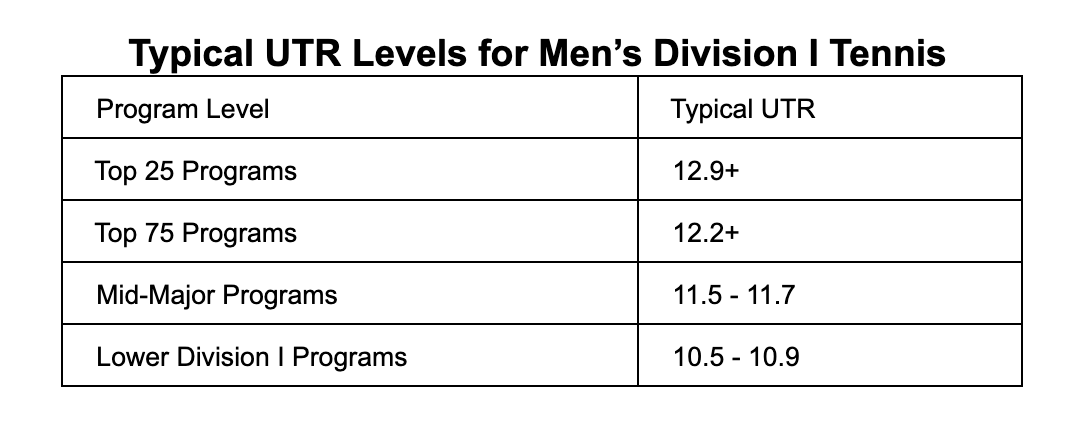
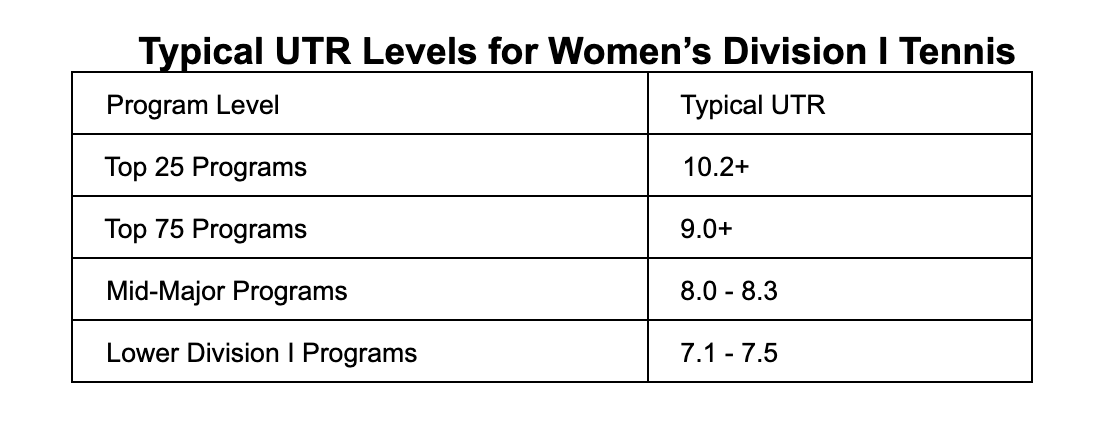
Even if a player’s UTR fits within these ranges, that still does not guarantee a Division I roster spot. Most Division I programs operate with a roster limit of ten players. Coaches must balance graduating seniors, returning starters, scholarship distribution, lineup depth, and international recruiting pipelines. A coach may believe a player has the right level but simply not have an available spot in that recruiting class.
Another major misconception is that all Division I programs offer a similar experience. In reality, the difference between the top and bottom of Division I tennis can be enormous. At the top programs, athletes may have access to world-class facilities, multiple coaches, strength and conditioning programs, sports medicine support, and significant scholarship funding.
At the lower end of Division I, resources and support can be far more limited. Facilities, travel budgets, and staffing levels may look very different. The players are still talented competitors, but the institutional investment is often dramatically different from what you see at the top programs. For families navigating recruiting, it helps to think of Division I tennis as two distinct divisions sharing the same name.
At American College Placement, we often remind families that the goal is not simply to play Division I tennis. The goal is to find the best overall college experience. For many players, that experience ultimately happens outside Division I.
Division II and Division III programs across the country offer excellent coaching, strong team culture, competitive tennis, and outstanding academic opportunities. In some cases, the top programs in Division II and Division III can rival or even exceed the level of many Division I teams.
UTR has brought tremendous clarity to the recruiting process. It provides a global performance rating that allows coaches and families to evaluate player level across regions and tournaments. Families should use these benchmarks as helpful guidelines - but UTR is only one part of the recruiting equation. Coaches also evaluate work ethic, coachability, academic profile, character, and long-term development potential.
The most successful recruiting journeys focus on finding the right academic, athletic, and personal fit. When families approach the process with an open mind and an honest evaluation of level, they give themselves the best chance to find a college environment where the student-athlete can truly thrive.
Interested in exploring college tennis opportunities?
American College Placement has helped hundreds of families navigate the recruiting process and find the right college fit. If you would like guidance evaluating your level, building a recruiting strategy, and identifying the schools that best match your goals, visit www.AmericanCollegePlacement.com to learn more.
When it comes to improving our tennis the thing that is most obvious is often the last thing we consider. Case in point, we all recognize that serve and return are the two most important shots in the game. They start every single point. There is no avoiding them. Yet, we so often spend the majority of our time on the practice court mindlessly exchanging baseline rallies. It makes no sense!
I attended the practice of my favorite player recently during a trip to Copenhagen. He and his partner were adjusting to the red clay and wanted to prioritize baseline rallies. After a good warmup, they played over 100 baseline points that started with a feed from the hand. They worked hard for over two hours.
My role on the day was to observe and give feedback afterwards. I was biting my tongue wondering why these two dedicated players weren’t starting each point with a second serve rather than a hand feed. They missed out on more than 50 chances each to practice the most important two shots in the game!
At the highest levels of tennis over 70% of the points last 4 shots or less. This statistic is for the very best players in the world. For more intermediate players it’s certainly much higher. Let’s challenge ourselves to back away from the grinding baseline practices. Rather, let’s gain confidence moving our second serve to multiple targets. Let’s feel comfortable mixing our positions for returns by taking some a little earlier than normal and some from further behind the baseline. You’ll be amazed at how adding these elements you can take your game to a higher level.
It's an exciting time of year for junior players. Those in the Class of 2024 are making final decisions, the Class of 2025 are taking official visits, and the Classes of 2026 and 2027 are building relationships with coaches.
Click the button and let us know if Coach Knoll can help you find the school of your dreams.
This is a question I hear every day. With the advent of social media and mass e-mail, it’s not always easy to tell.
Receiving a questionnaire from the coaching staff is a good sign. That alone doesn’t indicate that the coach views you as a potential member of the team. They may be reaching out to hundreds of prospects in your Class.
An invitation to attend a showcase or camp is also a common way for coaches to narrow their list. These invitations are hard to read as the coaches may simply be adding paying customers to their for-profit camp. It’s wise to ask questions about the nature of the event. How many other players will attend? What is the competitive level of the other campers? You want to be sure this is a targeted camp only for recruitable prospects. Otherwise, you may not have much contact with the coaching staff.
We encourage all our players to utilize the tennisrecruiting.net website. Each player can create a profile with their e-mail, phone number, and address. Players can also include academic credentials that are helpful to the coaches. Be aware that only coaches have access to this part of the site, so your personal information is relatively secure. HINT: Players will be notified each time a coach visits their page. This often creates the impression that coach is highly interested. When in fact, the coach may be quickly clicking through numerous profiles thoughtlessly.
A telephone call tells the tale. If a coach schedules a call and takes the time to personally interact you know you are firmly on their radar. Remember to be formal in your communication with coaches. It’s a good idea to conduct some practice calls in order to feel comfortable presenting yourself on the telephone.
Remember to enjoy the process! It’s something special to be recruited. You’ve worked hard and you deserve it!
Your time is limited. With school, practice, travel to tournaments and other responsibilities. Get focused on schools that line up with your data. It may sound harsh but college coaches have lots and lots of choices. Roster spots are limited so coaches aren’t looking to add players that aren’t good enough to make the lineup for developmental purposes.
As the leader of American College Placement people approach me daily for guidance on the college search process. Perhaps the best piece of advice I can give is, “Don’t Waste Time”. Use the available tools to create a realistic framework for your search. Get a professional to help you establish the right list of schools and hammer away at that list relentlessly.
An example from a parent, “Her documented UTR is 8.55 but she plays at the level of a 10. We are looking for someone who can communicate her potential to college coaches as her official stats aren’t reflecting her level.”
This is a parent that loves her daughter. My guess is there are teaching pros that have lavished her with praise and positive affirmation. This is wonderful for building a healthy young person. BUT, it sets up a dangerous dynamic as it comes to college recruiting. Using our first tool, UTR, we learned that her best win is over a player with a 8.68 UTR. She has a loss against a 7.6 UTR. The data just doesn’t line up with the idea that she’s under rated.