
Division I Tennis Recruiting: What UTR Do You Need to Play D1 College Tennis?
By Matt Knoll - Founder, American College Placement
One of the most common questions families ask during the college tennis recruiting process is simple: “What UTR do I need to play Division I tennis?” It is a fair question - and one that deserves a clear and honest answer. The reality is that the required level varies widely across Division I programs.
The biggest mistake families make is assuming that Division I tennis is a single level of play. In reality, Division I tennis is best understood as multiple tiers within the same division, with large differences in player level, program resources, and recruiting standards. Understanding these differences helps families approach the recruiting process with realistic expectations and better long-term decision making.
Let us begin with the numbers. Based on roster data and recruiting trends across the country, the following ranges provide a realistic snapshot of the typical level required at different tiers of Division I tennis.
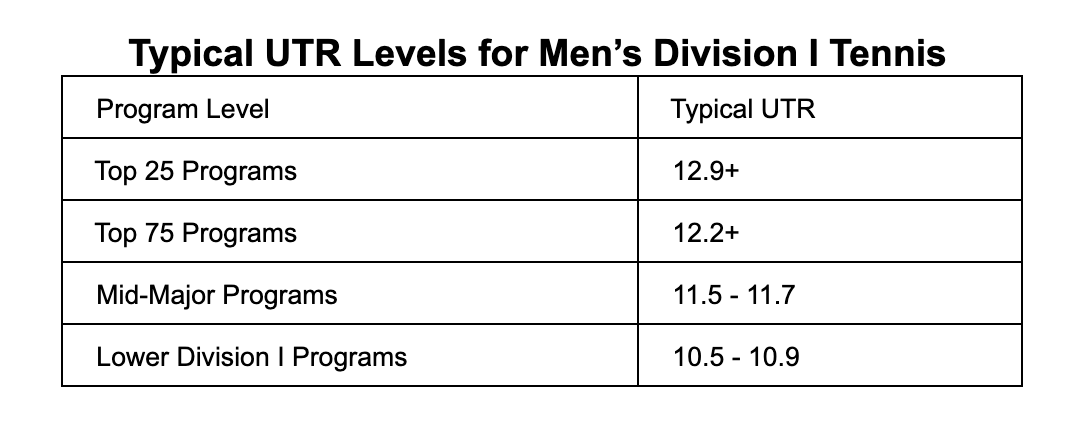
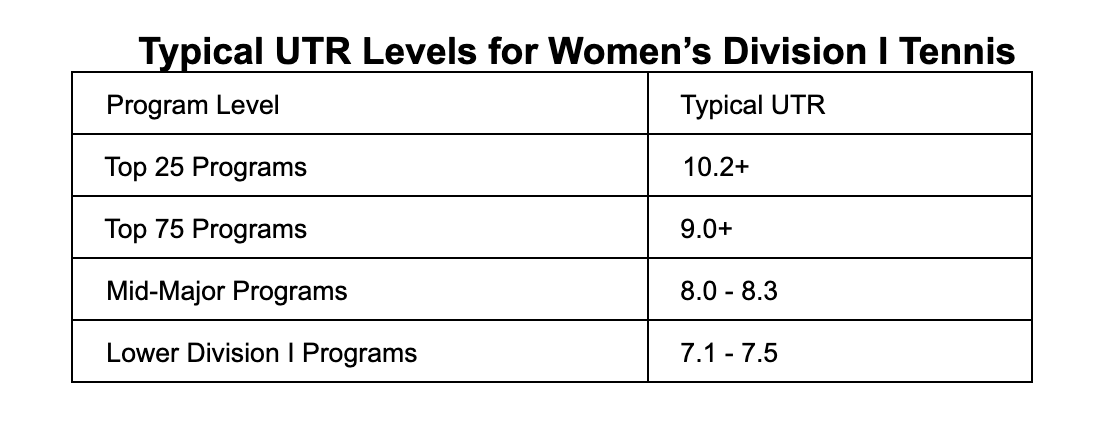
Even if a player’s UTR fits within these ranges, that still does not guarantee a Division I roster spot. Most Division I programs operate with a roster limit of ten players. Coaches must balance graduating seniors, returning starters, scholarship distribution, lineup depth, and international recruiting pipelines. A coach may believe a player has the right level but simply not have an available spot in that recruiting class.
Another major misconception is that all Division I programs offer a similar experience. In reality, the difference between the top and bottom of Division I tennis can be enormous. At the top programs, athletes may have access to world-class facilities, multiple coaches, strength and conditioning programs, sports medicine support, and significant scholarship funding.
At the lower end of Division I, resources and support can be far more limited. Facilities, travel budgets, and staffing levels may look very different. The players are still talented competitors, but the institutional investment is often dramatically different from what you see at the top programs. For families navigating recruiting, it helps to think of Division I tennis as two distinct divisions sharing the same name.
At American College Placement, we often remind families that the goal is not simply to play Division I tennis. The goal is to find the best overall college experience. For many players, that experience ultimately happens outside Division I.
Division II and Division III programs across the country offer excellent coaching, strong team culture, competitive tennis, and outstanding academic opportunities. In some cases, the top programs in Division II and Division III can rival or even exceed the level of many Division I teams.
UTR has brought tremendous clarity to the recruiting process. It provides a global performance rating that allows coaches and families to evaluate player level across regions and tournaments. Families should use these benchmarks as helpful guidelines - but UTR is only one part of the recruiting equation. Coaches also evaluate work ethic, coachability, academic profile, character, and long-term development potential.
The most successful recruiting journeys focus on finding the right academic, athletic, and personal fit. When families approach the process with an open mind and an honest evaluation of level, they give themselves the best chance to find a college environment where the student-athlete can truly thrive.
Interested in exploring college tennis opportunities?
American College Placement has helped hundreds of families navigate the recruiting process and find the right college fit. If you would like guidance evaluating your level, building a recruiting strategy, and identifying the schools that best match your goals, visit www.AmericanCollegePlacement.com to learn more.